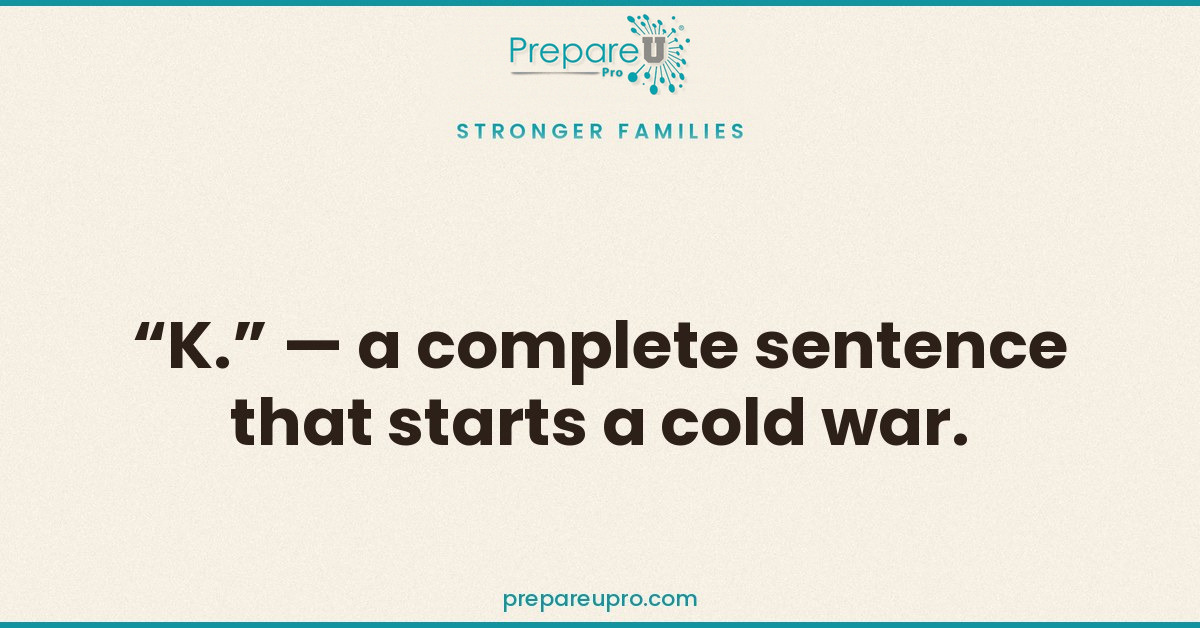
""K." - a complete sentence that starts a cold war."
The text said "K." That's all it said. And yet an entire intelligence agency spun up in your head within seconds: K, period. Not "kk," not "okay!", not even a thumbs up. K, full stop. Clearly furious. Possibly about the thing from Sunday. Definitely about the thing from Sunday. By dinnertime a cold war is underway between two people, one of whom was just driving and typed one letter at a red light.
Why it lands
The research on this is genuinely funny in a tragic way. Communication studies show a large share of emotional meaning travels through tone, face, and timing - all of which text deletes. What fills the vacuum is the reader's own state: a classic study by Justin Kruger and colleagues found people believe their texts and emails convey their intended tone far more than they actually do - senders assumed sarcasm and warmth were obvious; receivers guessed at little better than chance. And the gap fills pessimistically: negativity bias means ambiguous signals get read as threats, especially in relationships with history - which is to say, especially family, where every "K." gets decoded against forty years of archived grievances.
Add generational dialects (a period is neutral to your dad and hostile to your sister; the thumbs-up emoji is efficient to one generation and devastating to another) and family threads become translation disasters running 24/7.
Arms control for the group chat
1. Adopt the generous-read rule. Before assigning motive to a flat text, force the boring explanation first: driving, busy, bad at texting, over 50. The boring explanation is correct the vast majority of the time; the dramatic one just feels truer because it arrived with adrenaline.
2. Escalate the medium, not the conflict. The iron law of digital family peace: anything with emotional weight moves up a channel. Misread text → voice note or call. Thirty seconds of actual voice - with its actual tone - resolves what nineteen carefully drafted texts would inflame. Tone is the missing data; go get the tone.
3. Ask instead of decoding. The direct move feels almost embarrassing and works completely: "Hey - the 'K.' read a little cold. All good?" Nine times out of ten: "omg yes sorry, was in a meeting." You just canceled a cold war for the price of one slightly vulnerable question. Cheapest peace treaty in history.
Send this to someone
Send this to someone currently in day three of a conflict that started as punctuation.
Where this leads (3 minutes, free)
Before the next cold war, check the signal quality at home. The free GrowEQ check takes about three minutes and shows where you and your family stand across four areas that shape everyday life - meaning, purpose, relationships, and anxiety - so you can see exactly where the fastest gains are. No credit card, and the results are yours alone.
Prepare U Pro grew out of more than 10 years of the Prepare U curriculum in real classrooms - the research is public at prepareu.live.
Prepare U Pro is education and skill-building. It is not therapy, and it isn't a substitute for professional care. If your family is in crisis, please reach out to a licensed professional - in the US you can call or text 988 anytime. Find a crisis center near you.