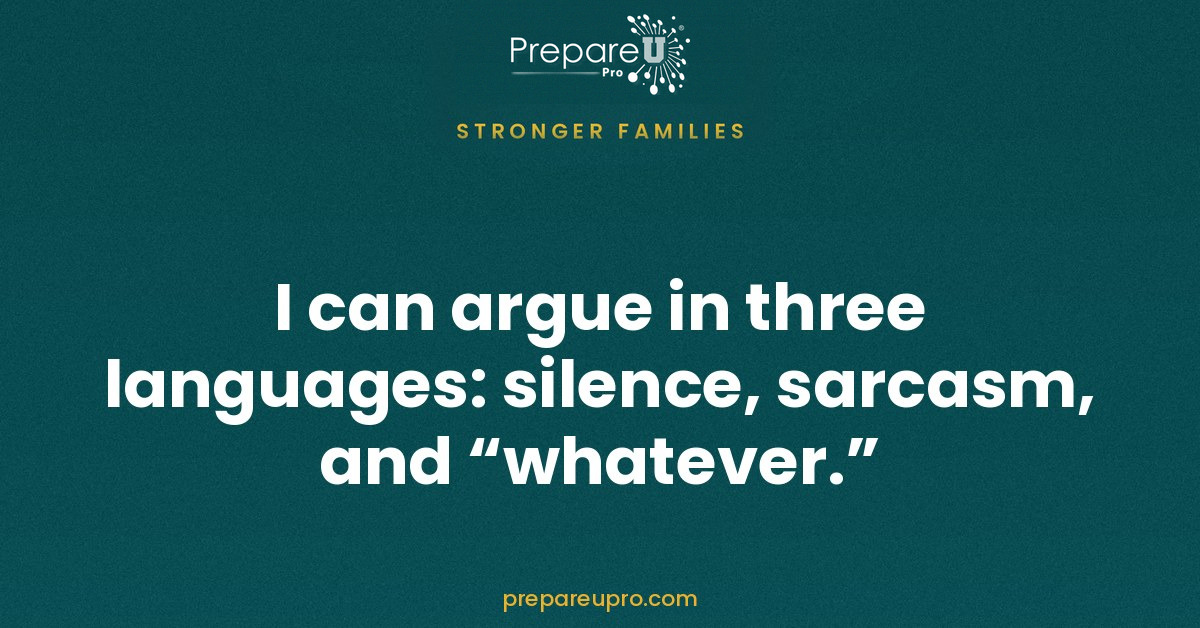
"I can argue in three languages: silence, sarcasm, and "whatever.""
Some families yell. Others have evolved past such crude technology into the advanced arts: the six-hour silence, the compliment with a blade in it, the "whatever" delivered with the emotional payload of a closing argument.
It is fluency. Every one of those is a complete sentence - encrypted so that if anyone objects, you can deny it was said at all.
Why it lands
Indirect anger exists for a rational reason: somewhere along the line, direct anger wasn't safe or wasn't allowed. So the anger learned to travel in disguise. The problem is the tax. Researchers who study conflict note that indirect hostility - especially stonewalling (the shutdown-and-silence move) - is among the most corrosive patterns a relationship can run, precisely because there's nothing for the other person to respond to. You can't repair a fight that officially isn't happening.
Sarcasm carries a similar cost: it's often contempt in a party costume, and contempt is the single strongest predictor researchers have found for relationships going bad.
Learning the fourth language
1. Say the quiet sentence. Every "whatever" has a real sentence trapped inside it - usually something like "that hurt" or "I don't feel heard." Once a day, catch one encrypted message before you send it and transmit the plain version instead. It will feel like walking out uncovered. Do it anyway.
2. Use the I-statement skeleton. "I felt ___ when ___ happened. I'd like ___." It's a cliché because it works: it delivers the anger and the request without launching an attack the other person has to defend against.
3. Take the 20-minute pause - announced. If you're flooded, silence is actually correct - physiologically, nobody communicates well mid-adrenaline. The fix is to label it: "I'm too worked up to do this well. Give me 20 minutes and I'll come back." Silence with a return time is regulation. Silence without one is a weapon.
Send this to someone
Send to your fluent speaker. They'll reply 'whatever,' which proves the point.
Where this leads (3 minutes, free)
If your family argues in silence, sarcasm, and "whatever," see what's underneath the encryption. The free GrowEQ check takes about three minutes and shows where you and your family stand across four areas that shape everyday life - meaning, purpose, relationships, and anxiety - so you can see exactly where the fastest gains are. No credit card, and the results are yours alone.
Prepare U Pro grew out of more than 10 years of the Prepare U curriculum in real classrooms - the research is public at prepareu.live.
Prepare U Pro is education and skill-building. It is not therapy, and it isn't a substitute for professional care. If your family is in crisis, please reach out to a licensed professional - in the US you can call or text 988 anytime. Find a crisis center near you.