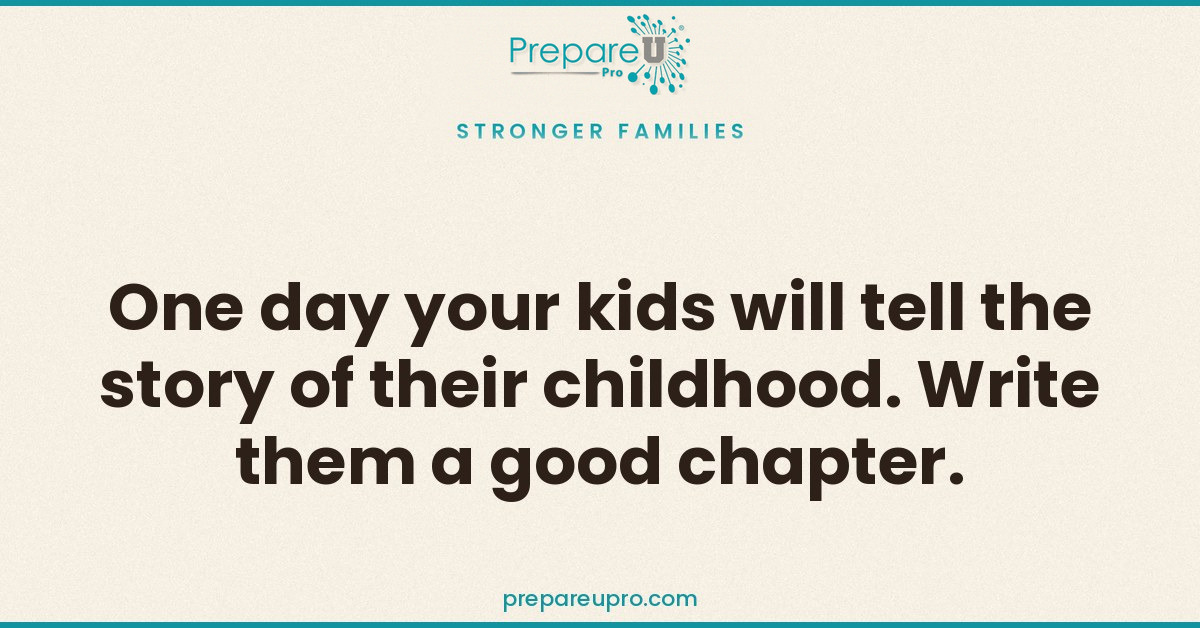
"One day your kids will tell the story of their childhood. Write them a good chapter."
Someday, in a dorm room or on a second date or in an office with a couch, your kid will be asked about their childhood - and they'll answer. In a few sentences. You, your whole complicated years of effort, compressed to a paragraph delivered to a stranger.
You don't get to write the paragraph. You do get to write the material.
Why it lands
Psychologists who study narrative identity (Dan McAdams' research tradition) have shown that people don't carry their childhoods as archives - they carry them as stories, edited and themed, and those stories shape identity more than the raw events did. Two kids can have similar childhoods and tell opposite stories, because the story is built from a specific kind of material: emotionally charged moments, repeated patterns, and - crucially - how things resolved. Related research on family storytelling found kids who know their family's narrative (including the hard parts and how the family came through) show more resilience and stronger identity.
Here's the practical translation: the paragraph won't quote your rules or your carpool logistics. It will quote the pattern ("she always...") and the peak moments ("there was this one time..."). Patterns and peaks. That's the whole manuscript.
Writing better material
1. Feed the "always." The paragraph's spine is a repeated pattern, so ask: what do I do so consistently they'll call it always? "He always came to my games." "She always knocked before entering." Pick one always you'd be proud to hear quoted, and defend it for years. Boring consistency is what becomes legend.
2. Resolve the bad scenes. The hard chapters will be in the story - that's fine, research says resolved struggle strengthens narratives. What matters is the ending: the repair, the apology, the "we figured it out." An unrepaired scene becomes a theme. A repaired one becomes a plot point.
3. Tell the family story out loud, imperfect parts included. Kids who hear "the time Dad lost his job and we ate a lot of pancakes and got through it" learn their family's genre: we're the kind of people who come through. Give them the genre. They'll write you generously in it.
Send this to someone
Send this to someone actively writing a chapter worth retelling.
Where this leads (3 minutes, free)
You're writing the chapters either way. See which ones need attention. The free GrowEQ check takes about three minutes and shows where you and your family stand across four areas that shape everyday life - meaning, purpose, relationships, and anxiety - so you can see exactly where the fastest gains are. No credit card, and the results are yours alone.
Prepare U Pro grew out of more than 10 years of the Prepare U curriculum in real classrooms - the research is public at prepareu.live.
Prepare U Pro is education and skill-building. It is not therapy, and it isn't a substitute for professional care. If your family is in crisis, please reach out to a licensed professional - in the US you can call or text 988 anytime. Find a crisis center near you.