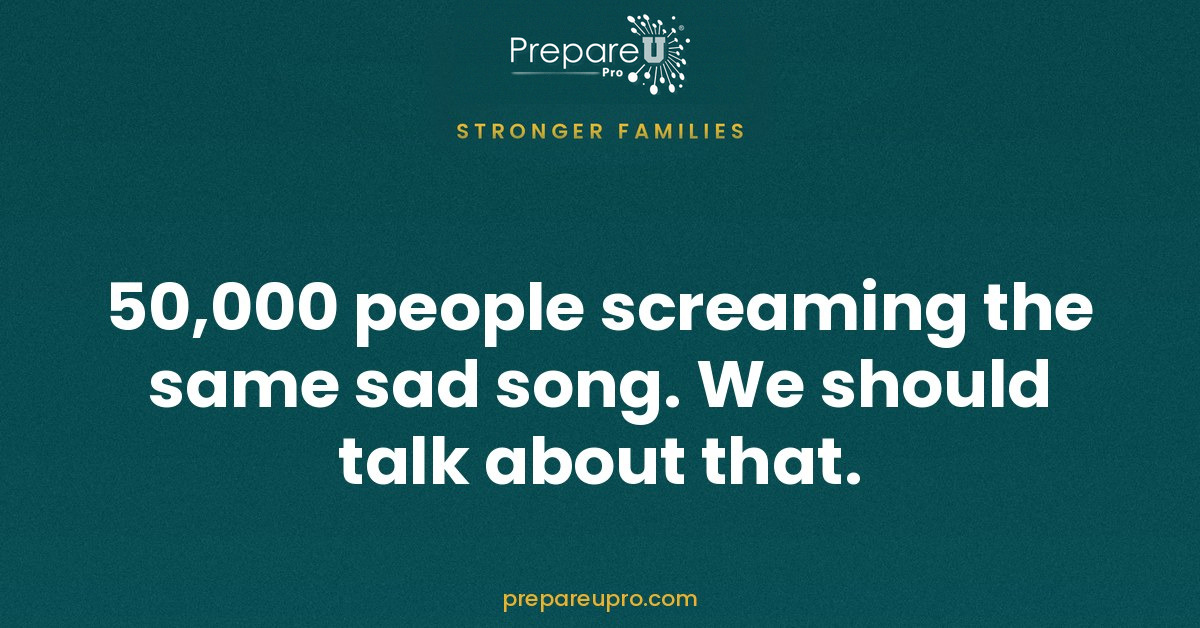
"50,000 people screaming the same sad song. We should talk about that."
Stand in any stadium during the sad song. Fifty thousand people, arms up, screaming lyrics about loss, regret, missing someone, being not-okay - with total strangers. Then Monday comes, mom asks how you're doing, and the entire arena in your chest answers: "fine."
We are not a culture that can't express feelings. We're a culture that outsources them to Adele.
Why it lands
Music gives us what psychologists call safe catharsis: all the emotional release with none of the interpersonal risk. Nobody at the concert will follow up. Nobody will worry, or use it against you at Thanksgiving, or make it a whole thing. Research on why we love sad music consistently points to this - it lets us feel the feeling while staying protected from the consequences of disclosing it.
The catch: the relief is real but the connection is borrowed. The song knows exactly how you feel and also has no idea you exist. Meanwhile the people who actually love you are working with "fine."
Bringing the arena home (small doses)
1. Use the song as the door. "This song wrecks me every time" is a feelings disclosure wearing a music review as a disguise. Send the track to your sibling with that one sentence. You've just said something true with a built-in escape hatch - which is exactly the right difficulty level.
2. Name one feeling, once a day, out loud. UCLA research on affect labeling shows that simply putting a feeling into words measurably calms the brain's alarm system. "I'm wound up today." Seven syllables. That's the rep.
3. Trade the follow-up question. When someone offers you their version of the sad song - a sigh, a "long day" - ask one question instead of matching it with your own "same." The concert works because everyone's singing. So does a family.
Send this to someone
Send this to your concert buddy - the one who cried at the bridge and then said 'anyway.'
Where this leads (3 minutes, free)
If it's easier to sing your feelings with 50,000 strangers than say them at home, it's worth finding out why. The free GrowEQ check takes about three minutes and shows where you and your family stand across four areas that shape everyday life - meaning, purpose, relationships, and anxiety - so you can see exactly where the fastest gains are. No credit card, and the results are yours alone.
Prepare U Pro grew out of more than 10 years of the Prepare U curriculum in real classrooms - the research is public at prepareu.live.
Prepare U Pro is education and skill-building. It is not therapy, and it isn't a substitute for professional care. If your family is in crisis, please reach out to a licensed professional - in the US you can call or text 988 anytime. Find a crisis center near you.