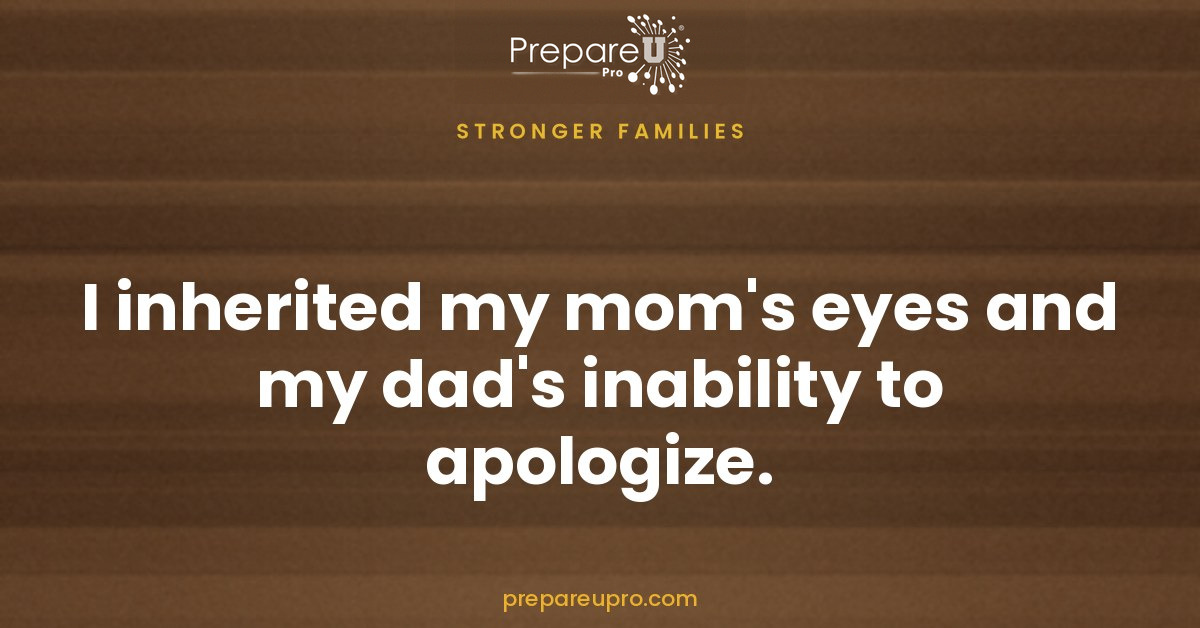
"I inherited my mom's eyes and my dad's inability to apologize."
The eyes came through DNA. The apology deficit came through demonstration: three decades of watching a man express regret exclusively through actions - the fixed thing, the extra twenty in your pocket, the unusually warm "drive safe" - while the words "I was wrong" remained in the vault, unfired, like a fine wine nobody's allowed to open.
And now you feel it in your own jaw: the physical resistance when an apology tries to exit.
Why it lands
This is social learning in its purest form - Albert Bandura's foundational research showed that children acquire behavior by observation far more than by instruction. Nobody sat you down and taught "we don't apologize here." You just never saw it done, so your brain filed apologizing under things our people don't do, somewhere between skydiving and salad.
Here's the mechanism worth knowing: for many people the block isn't pride, exactly - it's that apologizing was never modeled as survivable. If you've never watched a respected adult say "I was wrong" and remain respected, your nervous system treats the sentence as a cliff.
Becoming the first fluent speaker
1. Watch it survive. Find the counter-evidence deliberately: notice when a boss, a friend, a public figure apologizes well and comes out stronger. Your brain needs data that the cliff is a curb.
2. Start with the ninety-percent apology. If "I was wrong" won't launch, use its training wheels: "That came out worse than I meant - let me try again." It's an apology with a lower activation cost, and it builds the muscle the full sentence needs.
3. Say it once where the next generation can hear. The entire inheritance changes the first time a kid, a younger sibling, a nephew watches you say "I messed that up, I'm sorry" and nothing bad happens. One witnessed apology rewrites the family file. The eyes you can't help passing down. This, you can.
Send this to someone
Send this to whoever shares your eyes and your standoff record.
Where this leads (3 minutes, free)
You inherited the eyes and the standoff record. Only one of those is permanent. The free GrowEQ check takes about three minutes and shows where you and your family stand across four areas that shape everyday life - meaning, purpose, relationships, and anxiety - so you can see exactly where the fastest gains are. No credit card, and the results are yours alone.
Prepare U Pro grew out of more than 10 years of the Prepare U curriculum in real classrooms - the research is public at prepareu.live.
Prepare U Pro is education and skill-building. It is not therapy, and it isn't a substitute for professional care. If your family is in crisis, please reach out to a licensed professional - in the US you can call or text 988 anytime. Find a crisis center near you.