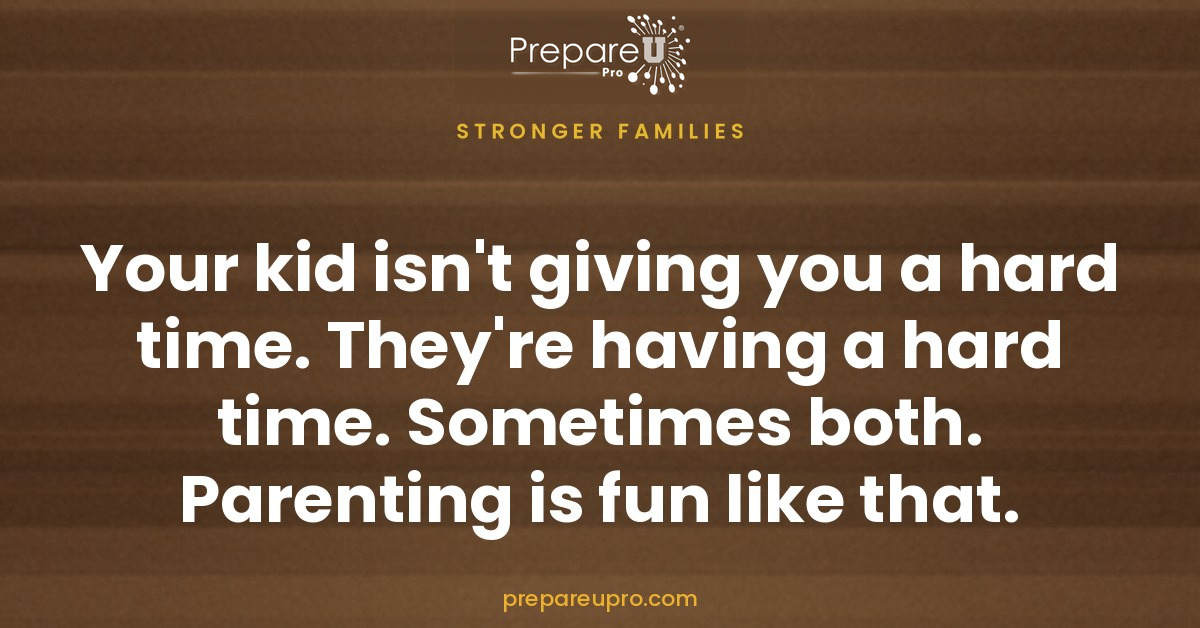
"Your kid isn't giving you a hard time. They're having a hard time. Sometimes both. Parenting is fun like that."
The reframe has earned its fame: the kid melting down in aisle five isn't executing a strategy against you - they're a small person whose coping capacity just ran out in public. "Giving you a hard time" assumes intent. "Having a hard time" reads the same behavior as signal: too tired, too hungry, too overwhelmed, too four.
And then there's the honest third clause, which is why the fridge-magnet version needed an update: sometimes it's both. Welcome to the sport.
Why it lands
The core insight is solid developmental science. Kids' behavior outruns their language and regulation for years - the systems that manage impulses and big feelings mature well into the twenties - so behavior is often the message: the whining is depletion, the defiance is a bid for control in a life with none, the aggression is a feeling with no vocabulary yet. Research on parental attributions adds the kicker: parents who read misbehavior as intentional ("he's doing this TO me") respond with more anger and harsher discipline, which escalates the behavior - a loop built entirely out of one interpretation. Reading behavior as signal measurably changes the parent's own physiology and response.
The "sometimes both" clause matters too, though: kids also test limits on purpose - that's healthy development, not a malfunction - and a reframe that erases all intent turns into a house with no boundaries. The skill isn't choosing one lens. It's holding both.
Responding to both truths
1. Run the HALT check before the discipline check. Hungry, Angry (about something else), Lonely, Tired? A staggering share of "behavior problems" are body problems wearing a behavior costume. Feed first, judge later - you'll be right more often than feels reasonable.
2. Address the need AND hold the line. Both-truths in one move: "You're exhausted and that's real - AND we don't hit. Let's get you to bed and try again tomorrow." Compassion for the state, boundary on the act. Kids need the pairing, not a choice between them.
3. Decode the repeat offender. A behavior that keeps recurring at the same time, place, or trigger is a message on a loop - map it for a week and answer the message (the transition is too abrupt, the evening is too long, the sibling comparison stings). Signals that get answered stop needing to escalate. Mostly. Sometimes both. Parenting is fun like that.
Send this to someone
Send this to a parent mid-hard-time. Both kinds.
Where this leads (3 minutes, free)
Hard time, or giving a hard time? A baseline helps you tell. The free GrowEQ check takes about three minutes and shows where you and your family stand across four areas that shape everyday life - meaning, purpose, relationships, and anxiety - so you can see exactly where the fastest gains are. No credit card, and the results are yours alone.
Prepare U Pro grew out of more than 10 years of the Prepare U curriculum in real classrooms - the research is public at prepareu.live.
Prepare U Pro is education and skill-building. It is not therapy, and it isn't a substitute for professional care. If your family is in crisis, please reach out to a licensed professional - in the US you can call or text 988 anytime. Find a crisis center near you.