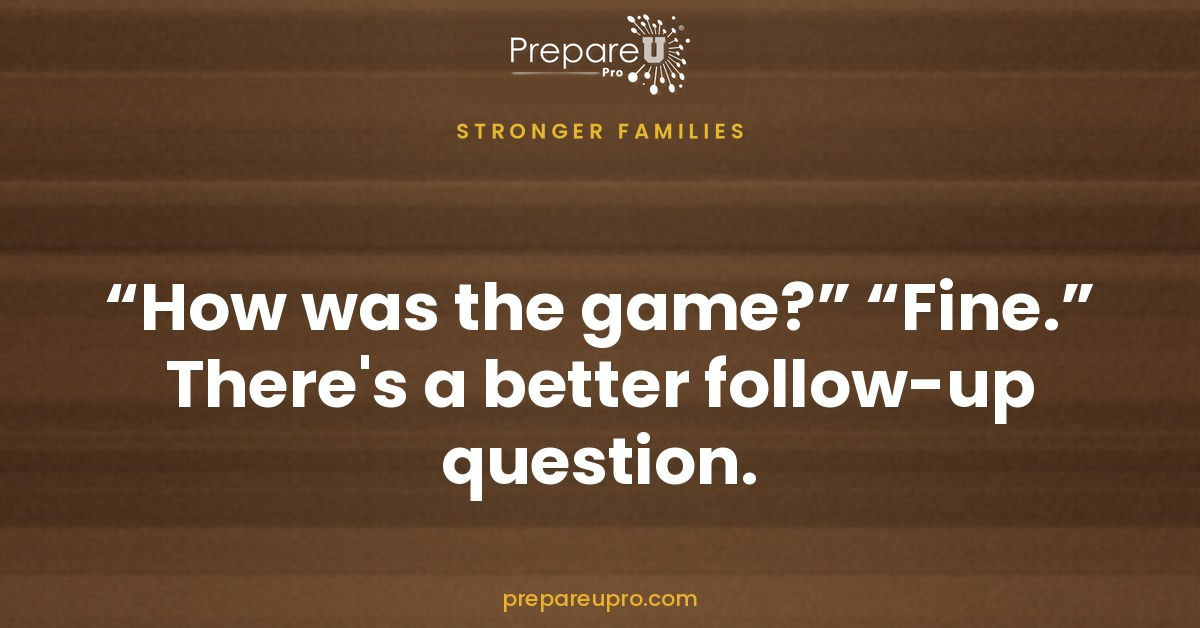
""How was the game?" "Fine." Scan for the follow-up question."
"How was the game?" "Fine." "How was practice?" "Fine." "How's the new coach?" "Fine." At this point "fine" is doing the work of an entire language - it means good, bad, complicated, embarrassing, none-of-your-business, and I'm-hungry, depending on inflection you're apparently supposed to decode.
Here's the reframe that changes the whole exchange: "fine" isn't a wall. It's a door with a handle. Most parents knock once and leave.
Why it lands
Conversation researchers have found that follow-up questions are disproportionately powerful - in studies, people who asked them were consistently rated as more likable and more caring, because the follow-up is proof the first question wasn't a formality. Kids run that same detector at higher sensitivity: the first question is you being a parent; the second question is you being interested. Most "fine"s are a test of whether question two exists.
The second finding: first answers are autopilot. Psychologists studying self-disclosure note real content usually surfaces after the scripted exchange completes - the good stuff is behind the "fine," not instead of it.
The follow-up playbook
1. Accept the fine, then go specific. Don't challenge it ("just fine?" reads as criticism). Route around it: "Fine like fun, or fine like long? ... What was the best two minutes of it?" Specific beats broad; either/or beats open-ended; small beats summary.
2. Ask about others, not them. Kids disclose sideways. "How did Marcus handle getting benched?" is answerable in a way "how do YOU feel" isn't - and their analysis of Marcus will tell you everything about their own inner weather. Sideways is a legitimate direction.
3. Bank one detail and redeem it later. Tonight's throwaway fact - the coach's weird speech, the ref, the kid who cried - becomes next week's opener: "Whatever happened with the ref situation?" Remembered details are the strongest interest-signal a parent can send. "Fine" families forget by dinner. Listening families keep receipts.
Send this to someone
Send this to a parent currently losing the 'fine' war. Reinforcements have arrived.
Where this leads (3 minutes, free)
Get past "fine" - starting with a reading on the whole family. The free GrowEQ check takes about three minutes and shows where you and your family stand across four areas that shape everyday life - meaning, purpose, relationships, and anxiety - so you can see exactly where the fastest gains are. No credit card, and the results are yours alone.
Prepare U Pro grew out of more than 10 years of the Prepare U curriculum in real classrooms - the research is public at prepareu.live.
Prepare U Pro is education and skill-building. It is not therapy, and it isn't a substitute for professional care. If your family is in crisis, please reach out to a licensed professional - in the US you can call or text 988 anytime. Find a crisis center near you.