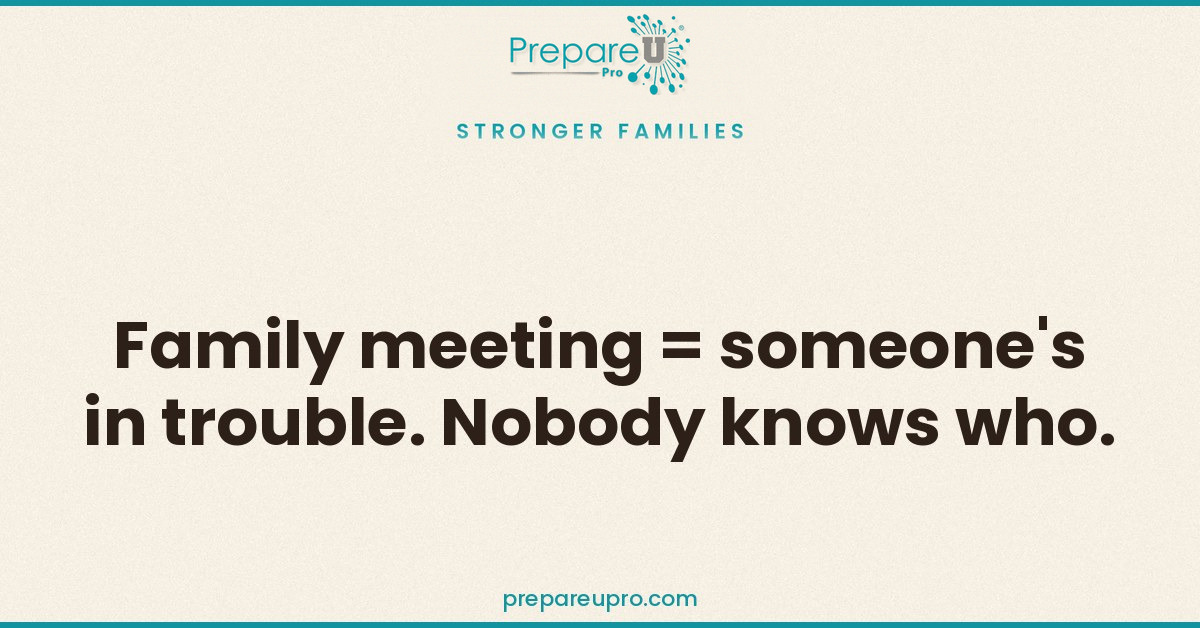
"Family meeting = someone's in trouble. Nobody knows who."
Two words, spoken from the kitchen, and every heart rate in the house changes: "Family meeting." Instantly, four people begin reviewing their recent activity like suspects. Whose grades? Whose credit card? Who left the garage open? The meeting hasn't started and everyone's already lawyered up.
That's the tell: in most homes, the family meeting isn't a communication tool. It's a tribunal with snacks. Sometimes without snacks, which is worse.
Why it lands
The dread is learned, and fairly: if assemblies only ever convene for verdicts, assembly itself becomes the punishment signal. It's basic conditioning. The shame is that the structured family conversation is genuinely one of the better-supported tools in the family playbook - research on family routines and rituals links regular, predictable connection points to better communication and stronger cohesion. Families that only meet in emergencies do all their talking at the worst possible moments, about the worst possible topics, in the worst possible mood.
The fix isn't abolishing the meeting. It's changing what meetings predict.
Running one nobody fears
1. Open with wins, every time, no exceptions. First agenda item is always each person's good thing from the week - 60 seconds around the table. This isn't fluff; it's reconditioning. When meetings reliably start with something pleasant, the words "family meeting" stop triggering the tribunal response within a month.
2. Rotate the chair - including the kids. Whoever runs it picks one topic and keeps time. Handing a ten-year-old the gavel transforms the meeting from something done to the family into something done by it, and research on kids' participation in family decisions links it to buy-in you cannot get by decree.
3. Cap it at 20 minutes and end with something good. Short enough that nobody dreads the runtime; ended with dessert, a show, a game - so the meeting's last association is positive. Consistency over duration: 20 minutes weekly beats a two-hour summit per crisis, because the whole point is having the channel open before someone's actually in trouble.
Send this to someone
Send this to your household with the caption 'family meeting about family meetings.'
Where this leads (3 minutes, free)
A family meeting runs better with a scouting report. Get yours first. The free GrowEQ check takes about three minutes and shows where you and your family stand across four areas that shape everyday life - meaning, purpose, relationships, and anxiety - so you can see exactly where the fastest gains are. No credit card, and the results are yours alone.
Prepare U Pro grew out of more than 10 years of the Prepare U curriculum in real classrooms - the research is public at prepareu.live.
Prepare U Pro is education and skill-building. It is not therapy, and it isn't a substitute for professional care. If your family is in crisis, please reach out to a licensed professional - in the US you can call or text 988 anytime. Find a crisis center near you.