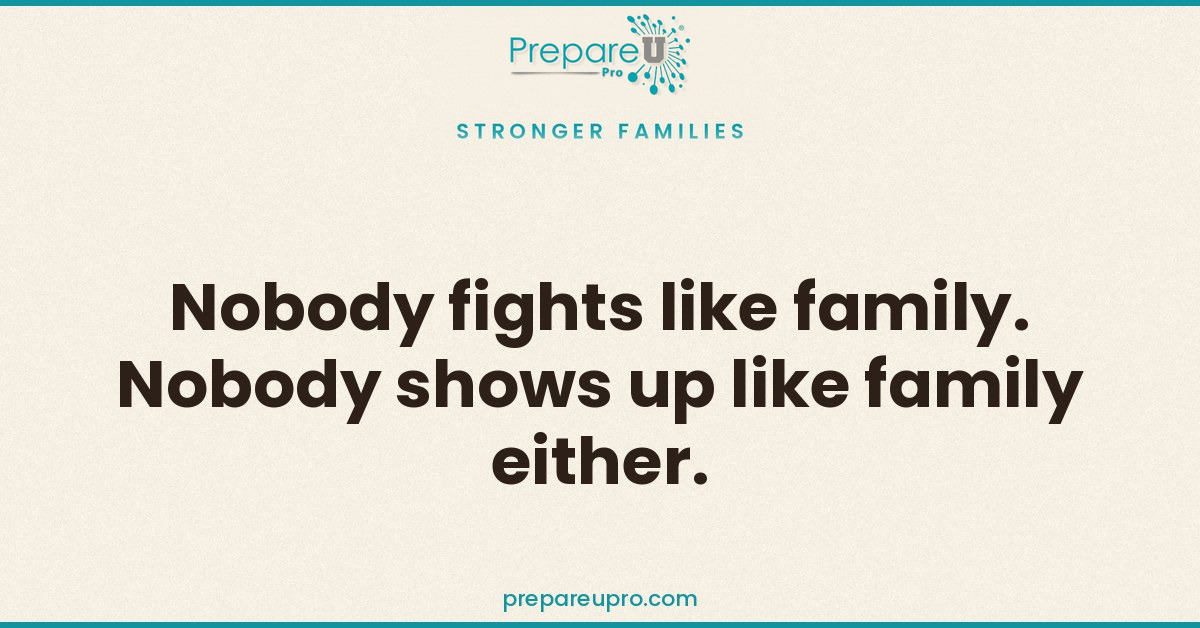
"Nobody fights like family. Nobody shows up like family either."
The same brother who once didn't speak to you for eight months over a wedding seating chart drove nine hours through the night when your world collapsed, no questions, arriving with gas station coffee and zero interest in being thanked. The aunt who critiques your life choices annually was the first one at the hospital.
Nobody fights like family. Nobody shows up like family. Both facts, same people, permanently.
Why it lands
Psychologists studying family ties have a term for this: ambivalence - the coexistence of genuine strain and genuine solidarity in the same relationship - and research on adult families finds it's not the exception but closer to the norm. The fighting and the showing-up even share a root: family fights hit harder because the stakes are total. Strangers can't wound you at that depth for the same reason they won't drive nine hours for you. High-stakes bonds cut in both directions.
The mistake is trying to resolve the ambivalence - sorting family into "good" or "toxic" and forcing every relationship into one bin. Some belong there. But many are simply both, and demanding they be one thing is how people end up either estranged from love or trapped in harm.
Holding both without picking one
1. Practice the both/and sentence. Literally: "My sister hurt me badly that year, AND she's the person I'd call first." Not "but" - and. Therapists across approaches teach this because "but" erases one truth to keep the other; "and" lets you carry accurate books on people, which is what makes wise decisions about them possible.
2. Thank the showing-up explicitly. Families notoriously log every fight and let the 3am drives pass unremarked. Flip the ledger once: "I never said it - you showing up that night mattered more than any of our arguments." Gratitude research is unambiguous about what naming it does to a bond, and in ambivalent relationships it feeds the side you want to grow.
3. Set boundaries with warmth, not exile. Both-things-are-true has a practical form: "I love you, and I'm not discussing my marriage at dinner." Boundary AND bond in one sentence. The relationship gets to keep its 3am clause without you paying the full tax of the fighting.
Send this to someone
Send this to the person you've fought with hardest - who also showed up hardest.
Where this leads (3 minutes, free)
Both things are true - and you can measure which one needs the work. The free GrowEQ check takes about three minutes and shows where you and your family stand across four areas that shape everyday life - meaning, purpose, relationships, and anxiety - so you can see exactly where the fastest gains are. No credit card, and the results are yours alone.
Prepare U Pro grew out of more than 10 years of the Prepare U curriculum in real classrooms - the research is public at prepareu.live.
Prepare U Pro is education and skill-building. It is not therapy, and it isn't a substitute for professional care. If your family is in crisis, please reach out to a licensed professional - in the US you can call or text 988 anytime. Find a crisis center near you.