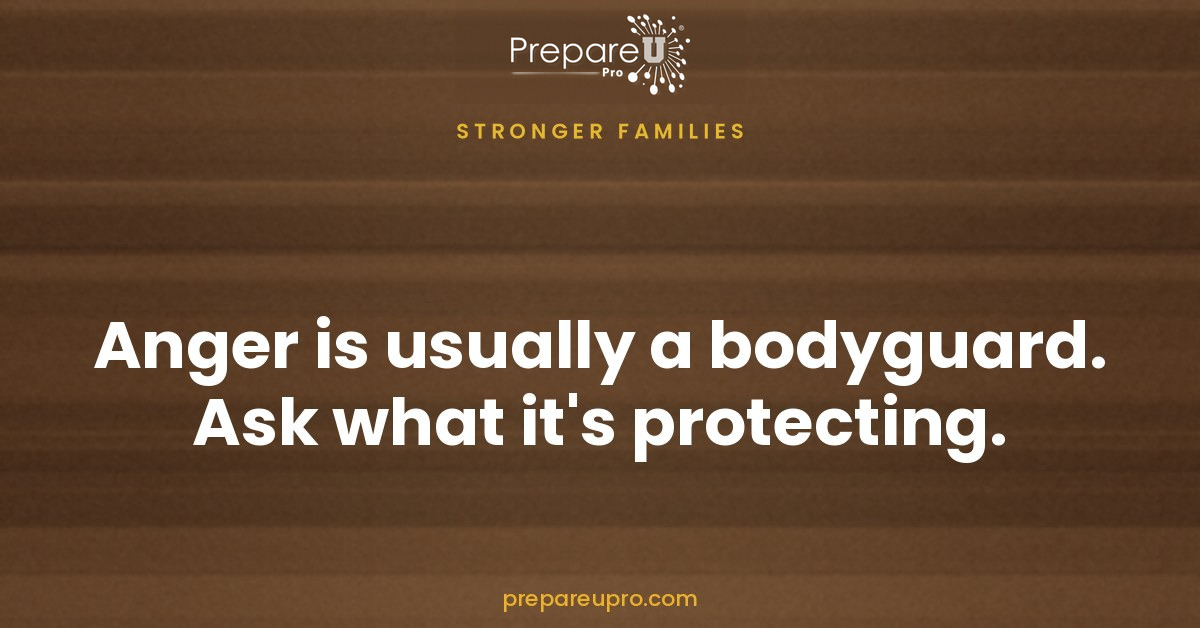
"Anger is usually a bodyguard. Ask what it's protecting."
Anger gets treated like the crime. Look closer and it's almost always the security detail - big, loud, standing in the doorway so nobody gets a look at what's behind it. And behind it is always something softer with worse PR: hurt, fear, embarrassment, exhaustion, the feeling of not mattering.
The kid slamming the door isn't the anger. The anger is guarding the humiliation from what happened at school. Your explosion about the dishes isn't the anger. It's guarding "I feel invisible in this house."
Why it lands
Clinicians widely describe anger as a secondary emotion - the fast, protective response that fires on top of a more vulnerable primary one (the popular "anger iceberg" is this exact model). There's a physiological logic: anger is energizing and armored, while hurt and fear are exposed. When vulnerability shows up, the nervous system often hires anger within milliseconds because anger feels powerful - outsourcing the pain to a guard who punches things.
The practical problem: people respond to the bodyguard. They argue with the anger, punish the anger, match the anger - and the soft thing behind it never gets seen, so it hires the guard again tomorrow. Emotion research (including the affect-labeling studies) shows that accurately naming the underlying feeling is what actually turns the volume down.
Interviewing the bodyguard
1. Ask the one question - of yourself first. Mid-anger or after: "What is this protecting?" Hurt? Fear? Shame? Feeling dismissed? The answer usually arrives embarrassingly fast, which tells you it was standing right there.
2. Speak from behind the guard. "I'm not just mad - I was really hurt that no one asked how it went." Vulnerable, yes. Also the only version the other person can actually respond to. Nobody can comfort a bodyguard.
3. See other people's guards too. When your kid or partner detonates, try reading past the detail: "That's a lot of anger - what got hurt?" Half the time the guard stands down simply because someone finally addressed the client.
Send this to someone
Send this to someone whose bodyguard has been working overtime lately.
Where this leads (3 minutes, free)
Interview the bodyguard - then check what the whole security system is protecting. The free GrowEQ check takes about three minutes and shows where you and your family stand across four areas that shape everyday life - meaning, purpose, relationships, and anxiety - so you can see exactly where the fastest gains are. No credit card, and the results are yours alone.
Prepare U Pro grew out of more than 10 years of the Prepare U curriculum in real classrooms - the research is public at prepareu.live.
Prepare U Pro is education and skill-building. It is not therapy, and it isn't a substitute for professional care. If your family is in crisis, please reach out to a licensed professional - in the US you can call or text 988 anytime. Find a crisis center near you.