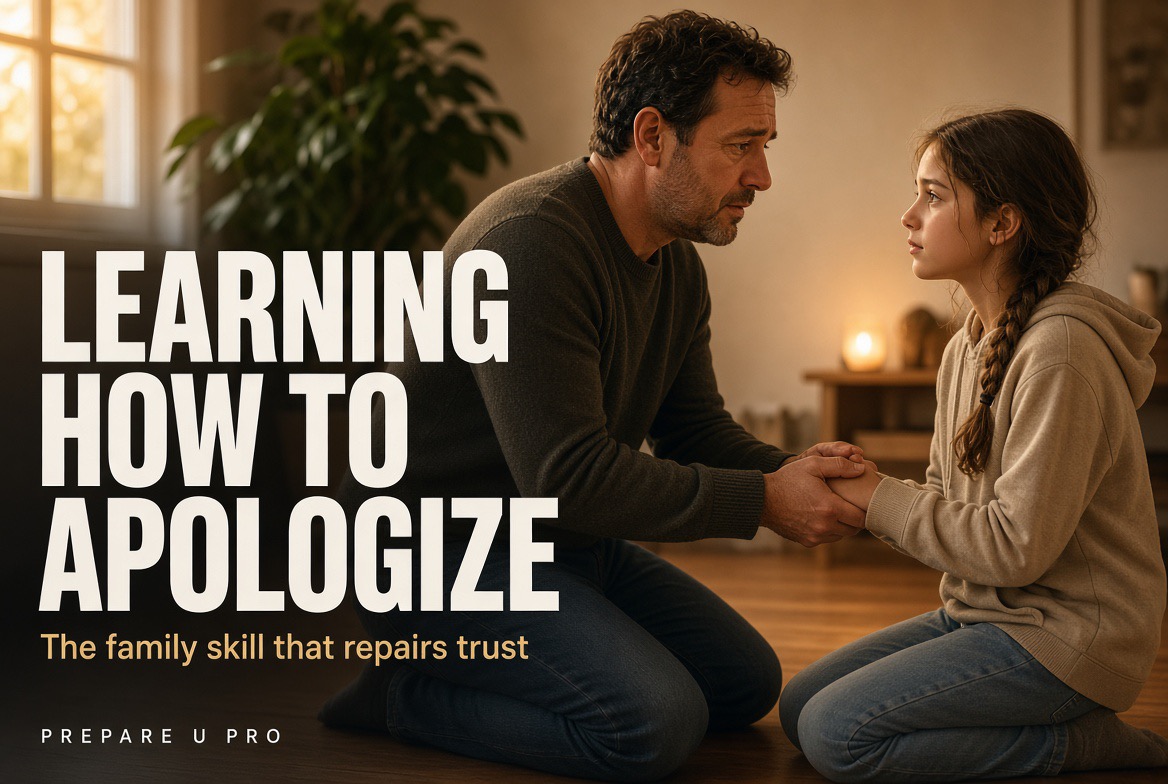
Twelve years of school. Quadratic equations, the periodic table, the causes of the War of 1812. Number of classes on how to say “I hurt you and I’m sorry”: zero.
That’s the joke, and the joke lands because it’s an audit. Most of us are running adult relationships on apology software we wrote as eight-year-olds — the mumbled “sorryyy,” the “sorry if you were offended,” the classic “sorry, but.” We’re not bad people. We’re untrained people.
Why it lands
Researchers who study apologies (Roy Lewicki’s team at Ohio State ran one of the best-known studies) found that apologies aren’t judged by how bad you feel — they’re judged by specific components. The ones that carry the most weight: acknowledging responsibility and offering repair. The ones that carry almost none: vague regret and explanations. In other words, the apology you were never taught is a skill with parts, like an equation. You just never got the formula.
There’s a second reason it lands: apologizing to family is uniquely hard. With strangers, the stakes end when the interaction ends. With family, an apology feels like updating the permanent record — admitting the pattern, not just the moment. Which is exactly why it’s the highest-value skill in the house.
The 3-part apology (use it tonight)
1. Name the specific thing. Not “sorry about earlier.” Say the actual behavior: “I cut you off in front of everyone at dinner.” Specificity is what tells the other person you actually saw what they experienced.
2. No “but.” The word “but” deletes everything before it. “I’m sorry, but you started it” is not an apology; it’s an opening argument. If an explanation truly matters, it can have its own conversation later.
3. Offer one repair. “Next time I’ll wait until you finish” or “Can I make it right by ___?” Repair converts an apology from a mood into a plan.
Practice small. Don’t debut this on the ten-year wound. Apologize well for the tiny stuff — the interrupted sentence, the forgotten errand — and the muscle will be there when it matters.
Send this to someone
Send this to the person you took a math class with — or the one who’s still waiting on the apology.
Where this leads (3 minutes, free)
If nobody taught you to apologize, nobody measured what the gap costs, either. Start with a baseline. The free GrowEQ check at prepareupro.com takes about three minutes and shows where you and your family stand across four areas that shape everyday life — meaning, purpose, relationships, and anxiety — so you can see exactly where the fastest gains are. No credit card, and the results are yours alone.
Prepare U Pro grew out of more than 10 years of the Prepare U curriculum in real classrooms —
Prepare U Pro is education and skill-building. It is not therapy, and it isn’t a substitute for professional care. If your family is in crisis, please reach out to a licensed professional — in the US you can call or text 988 anytime.